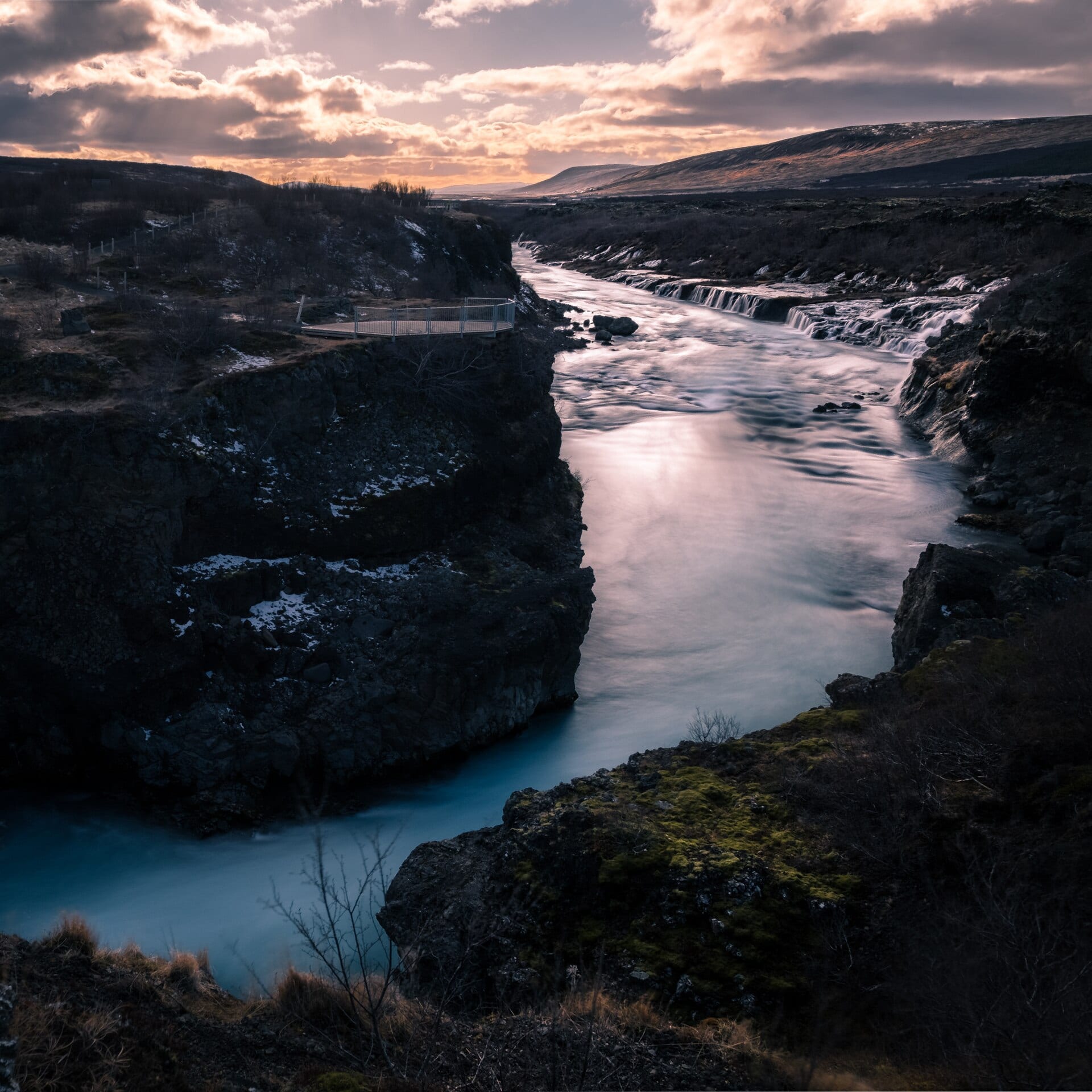
Water appears here without drama. It simply rises through the lava, finding gaps in the porous basalt, and slides quietly into the river below. Hraunfossar is not a plunging curtain of water. It is something more unusual: a slow, wide seep stretching nearly a kilometre along a low cliff of ancient lava, producing a continuous, almost silver fringe against the dark rock. If you arrive expecting the spectacle of Skógafoss or Seljalandsfoss, you may need a moment to recalibrate. Give it that moment.
Why it’s worth the trip
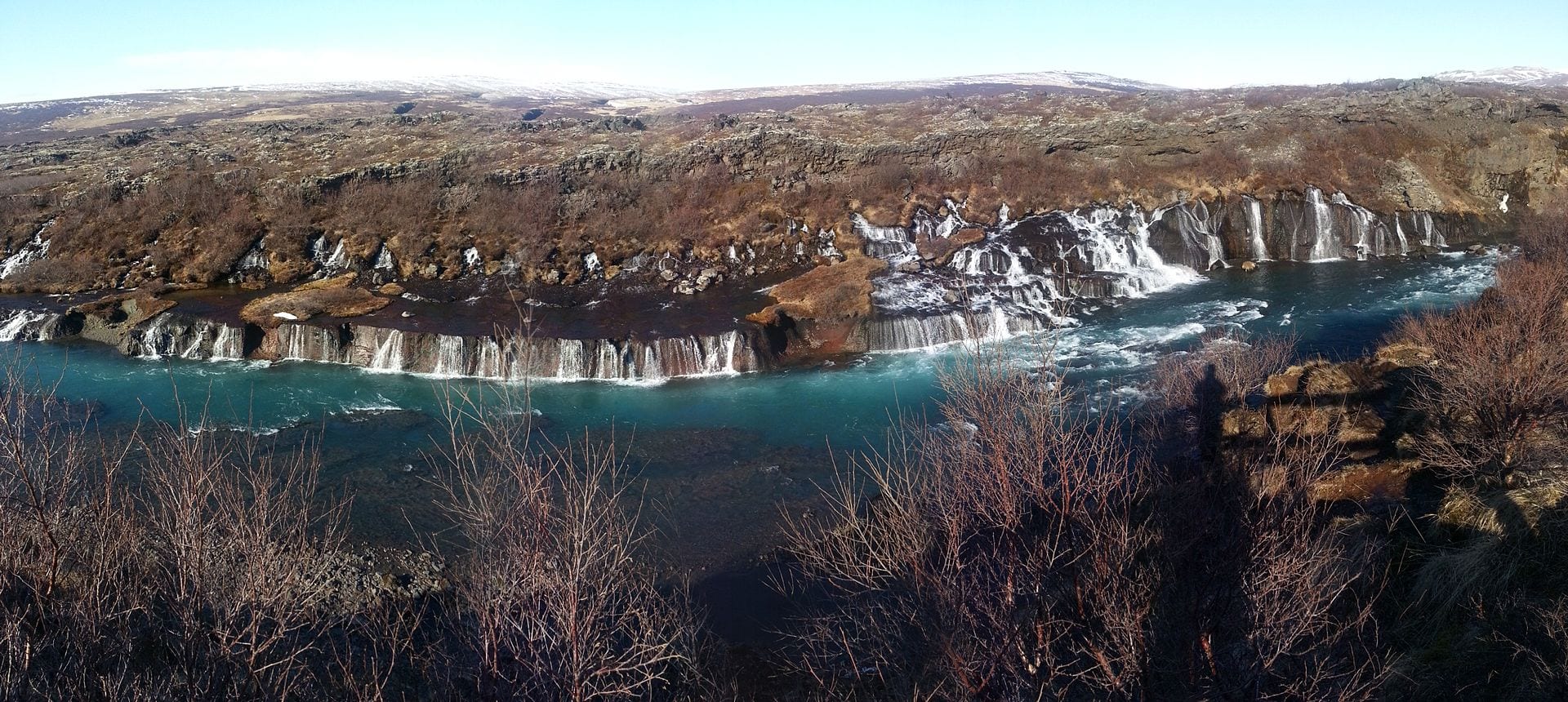
The geological situation here is genuinely uncommon. The lava field above, known as Hallmundarhraun, was produced by an eruption beneath the Langjökull glacier, probably around 900 years ago. Meltwater and precipitation percolate down through the porous lava over a long distance before emerging at the riverbank in hundreds of small springs. Because the lava acts as a natural filter, the water runs exceptionally clear. You can see it threading between the basalt columns and mossy ledges in thin, translucent sheets. The river it enters, the Hvítá, runs milky grey with glacial sediment, so the contrast between the two is sharp and immediate.
That contrast is the heart of the experience: clear spring water meeting opaque glacial river, all along a low, accessible bank. There is no single point where the falls are most impressive. The whole 900 metre stretch is the attraction.
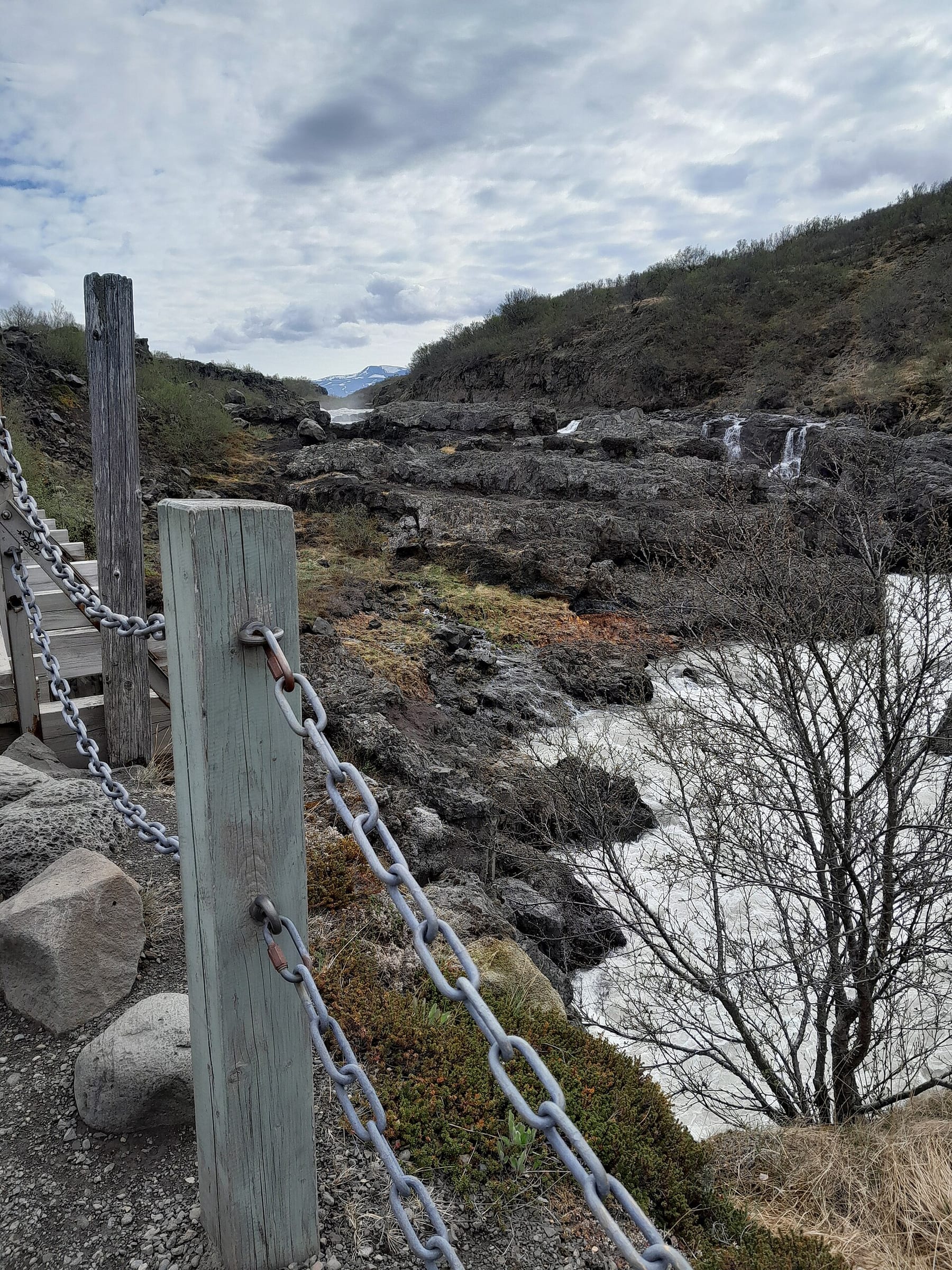
Barnafoss, a few minutes’ walk upstream, is a different character entirely. The Hvítá here forces itself through a narrow gorge of jagged basalt in fast, churning rapids. The geology is the same lava field, but here erosion has cut a slot through it. The name translates roughly to Children’s Falls, and there is a grim folk story attached to it involving two children who fell from a natural stone arch that once crossed the gorge. The arch no longer exists, reportedly removed by a grieving parent. The story may be embellished, but the gorge itself is real and physically impressive in a way that contrasts usefully with Hraunfossar’s calm.
Together the two sites give you a surprisingly complete picture of what water does when it encounters basalt over time. That is not a minor thing.
How to get there
Both falls lie along Route 518, which branches off Route 1 (the Ring Road) near Borgarnes and continues inland toward Húsafell and Langjökull. The drive from Borgarnes takes roughly an hour on paved road. From Reykjavík, allow around two hours, depending on your starting point.
The site is well signposted. There is a car park directly beside the falls, and the infrastructure here has been developed enough that you will not be navigating a remote track. This is a genuinely easy stop on the way to or from the Snæfellsnes Peninsula, or as part of a loop through the Borgarfjörður region. It pairs naturally with a visit to Húsafell to the east, or with the glacier tours on Langjökull if you are planning a longer day inland.
What to expect on arrival
The car park and the main viewing area for Hraunfossar are close together. A path runs along the riverbank, and the falls themselves are visible almost immediately. The walk to Barnafoss is short and flat. The terrain is accessible for most visitors, including those who are not confident on rough ground, though the lava rock near the water’s edge can be slippery when wet.
Looking down at Hraunfossar from the bank, the scale takes a moment to register. You are not standing at the top of a cliff. The drop is modest, a few metres at most in places, and the water does not so much fall as it glides and drips and pours from multiple points simultaneously. The total effect is of a low, continuous veil. Walk the full length if you can, because the character of the springs changes as you move along the bank. Some sections are denser with flow, others more sparse.
At Barnafoss, the mood shifts. The gorge is narrow and the water noise is considerably louder. The viewing points look down into the channel. Do not attempt to get closer to the water than the designated areas allow. The rock is irregular and wet, and the current in the gorge is fast enough to be dangerous.
The site has facilities on site, though you should not assume anything extensive. Plan accordingly, especially if travelling with children or in a group.
When to go
Hraunfossar and Barnafoss are accessible in every season, and each has something distinct to offer. In summer, the surrounding vegetation is green and the long daylight hours mean you can visit at almost any time. Spring brings snowmelt and higher water volume in the Hvítá, which amplifies the visual contrast between the clear spring water and the grey glacial flow. Autumn, particularly September and early October, adds colour from the low-growing birch and dwarf shrubs on the lava field above.
Winter visits are possible and the falls remain active, since the springs emerge at a relatively stable temperature and do not freeze as readily as surface streams. Ice formation on the lava ledges around the springs can alter the appearance significantly, and the low winter light changes the colour and texture of the water. However, the path along the bank can be icy, so footwear with grip is advisable. Visibility is reduced in the shorter days, and weather in this part of Iceland in January or February can be unreliable. Come prepared for conditions to change quickly regardless of season.
Tips and responsible-visitor notes
A few practical points worth knowing before you go:
- Stay on established paths. The lava field above the falls is part of a fragile ecosystem and the moss recovers slowly from foot traffic.
- The bank near the water can be slippery at any time of year. Step carefully, particularly if you move away from the main path to get a better angle.
- Early morning visits in summer are calmer. The site is popular and can feel crowded at midday in July or August.
- If you are driving the Ring Road and treating this as a quick detour, allow at least 90 minutes. The falls deserve a slower pace than a 20-minute stop allows.
- Photography is best on overcast days, when the soft light reduces glare on the water and brings out the colour contrast between the clear springs and the glacial river.
The combination of Hraunfossar and Barnafoss is genuinely one of the more interesting geological stops in West Iceland, not because of scale, but because of what it shows you about the relationship between lava, water, and time.
.jpeg)

