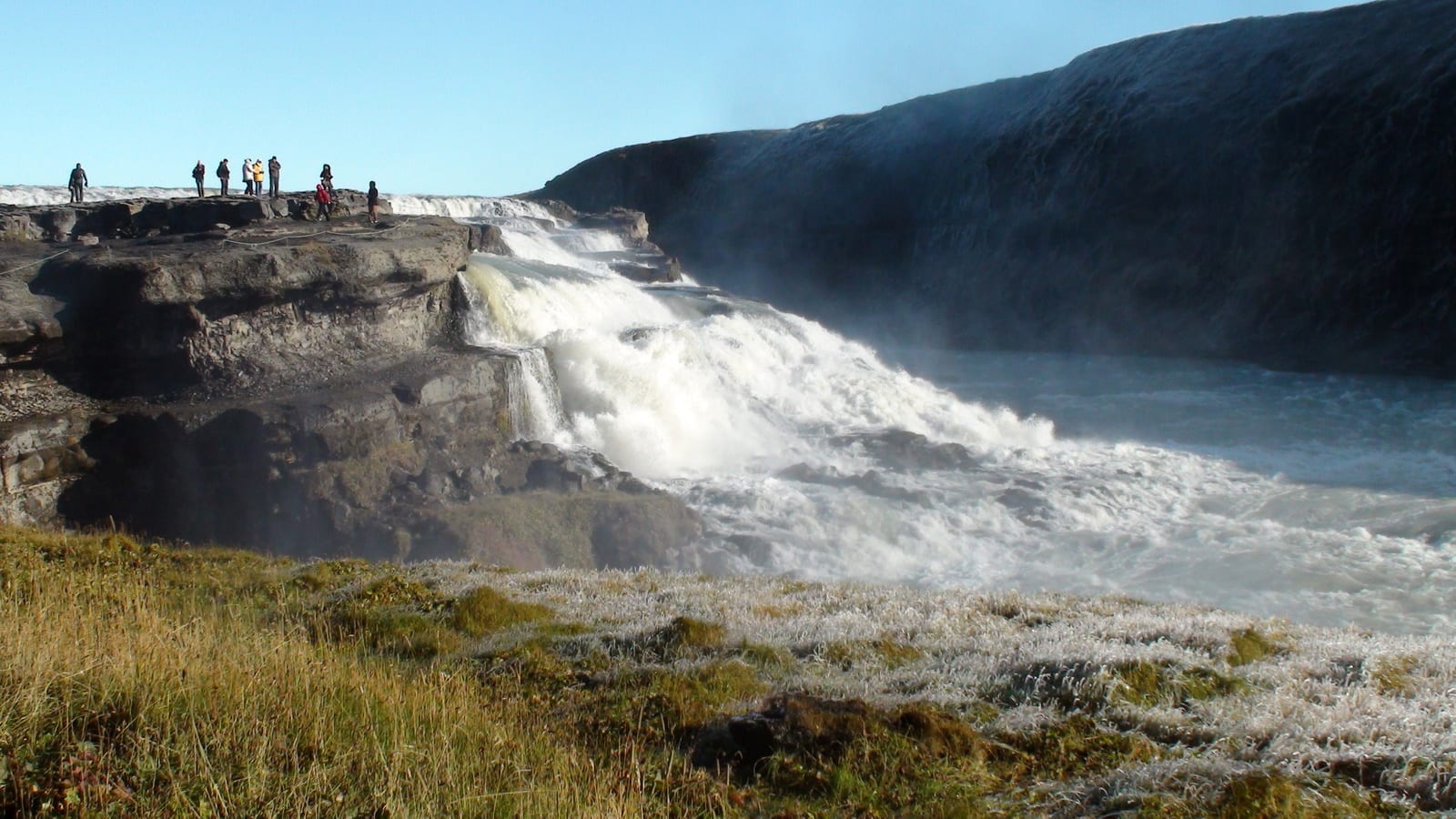
Gullfoss is loud before it is beautiful. You hear the Hvítá river crashing downward well before you reach the canyon rim, and that sound sets the tone for what follows: a place defined less by scenery than by sheer physical force. Two wide steps of falling water, a narrow gorge cutting roughly 70 metres into the earth, and a spray cloud that hangs in the air on calm days and disappears sideways in the wind on bad ones. It is exactly as dramatic as you have heard, and it is also well-managed, accessible, and genuinely worth the drive.
Why it’s worth the trip
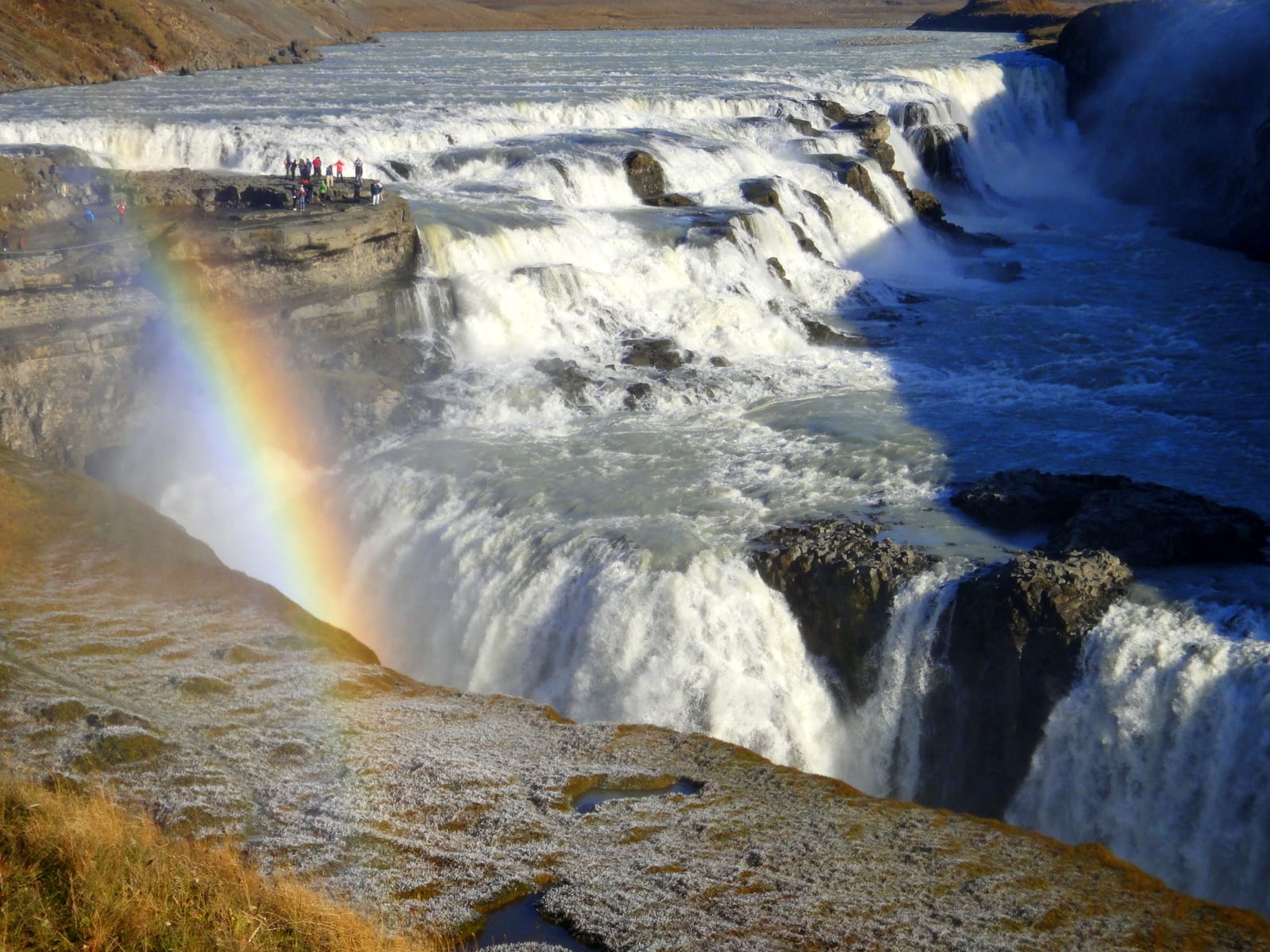
Most large waterfalls in Iceland are single drops. Gullfoss works differently. The Hvítá river first drops a short first tier, widens briefly across a rocky ledge, then falls again at a near-right angle into the canyon below. Because the second drop runs perpendicular to the first, the water seems to vanish into the earth rather than simply plunge off an edge. Standing on the lower viewing path, you look almost directly into the gorge, which makes the scale harder to read at first. It takes a moment to understand what you are seeing.
The canyon walls are layered basalt, dark grey and striated, worn smooth in some places and fractured in others. The gorge runs northeast, and because of its orientation, morning light can reach the falls in summer while afternoon visits put the canyon in partial shade. Neither is the “wrong” time; they just look different. On sunny days the mist generates rainbows over the lower falls, which is pleasant but also means the viewing platform gets considerably more crowded when the sun is out.
Iceland’s early 20th-century history around Gullfoss matters too. The falls were nearly converted into a hydroelectric project in the 1920s, and the landowner’s daughter, Sigríður Tómasdóttir, is widely credited with fighting to preserve them. A small monument to her stands near the upper path. It is not an elaborate memorial, but knowing the context changes how you look at the place.
How to get there
Gullfoss sits at the end of Route 35, roughly 115 kilometres from Reykjavík. The road is paved the entire way and passable in a standard two-wheel-drive vehicle during fair conditions. In winter, Route 35 is maintained but can be icy or snow-packed; check road conditions through the Icelandic Road and Coastal Administration (road.is) before you leave.
The waterfall is the last major stop on the Golden Circle route, usually visited after Þingvellir and the Geysir geothermal area. Most visitors drive east along Route 36 to Þingvellir, then south to Geysir via Route 365 and 37, then northeast on Route 35 to Gullfoss. You can also reverse the direction or drive straight from Reykjavík to Gullfoss first if you prefer to arrive before the midday crowd. The parking area is large and clearly signed. A visitor centre with a café and toilets is located on the approach to the falls.
What to expect on arrival
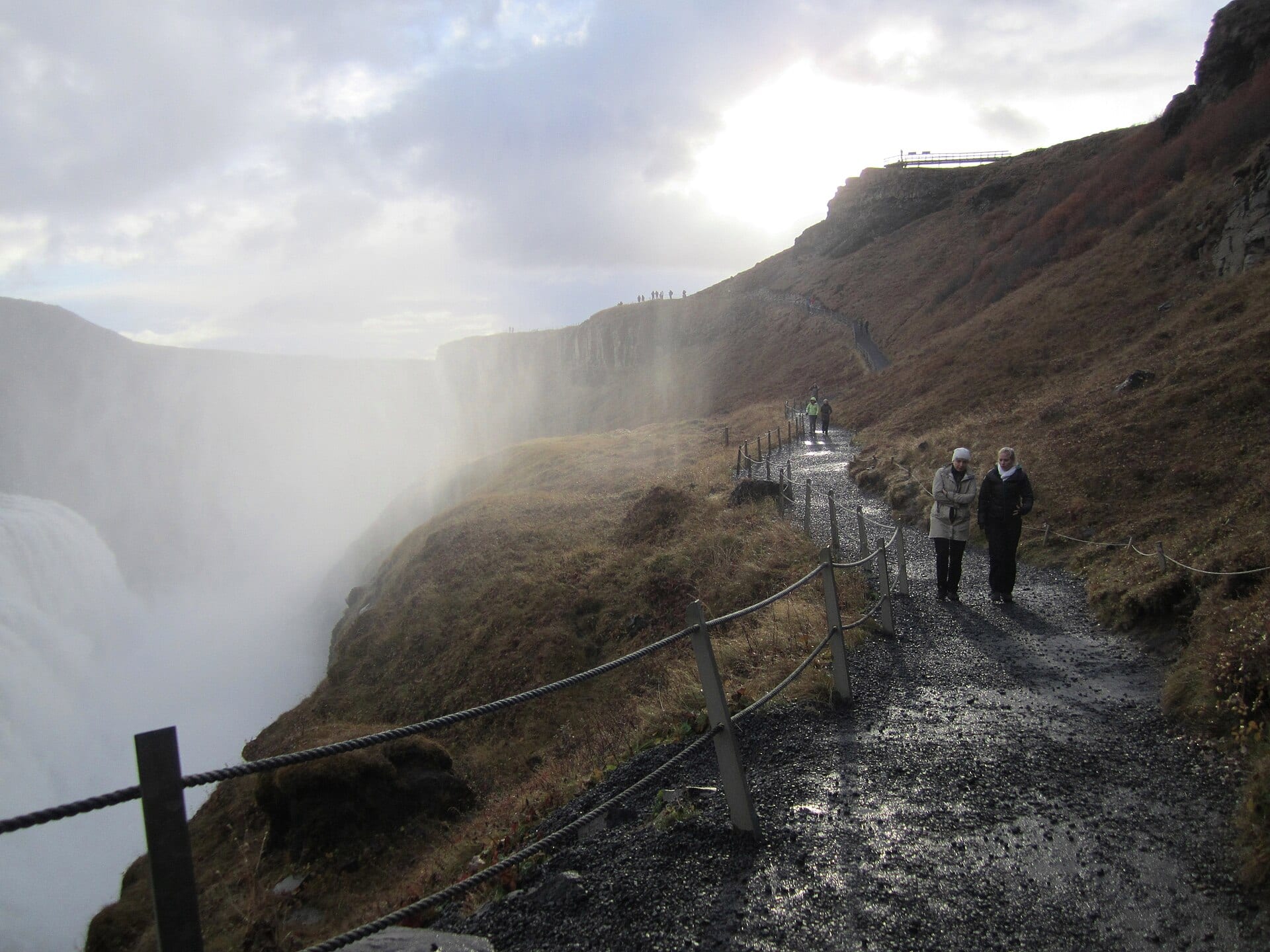
From the visitor centre, two main paths lead to the falls. The upper path runs along the canyon rim and offers a broad view of both tiers and the gorge below. The lower path descends closer to the river level and brings you to within a short distance of the falling water itself. Both paths are surfaced and relatively flat. The lower path gets very wet on calm or windless days when the spray drifts directly toward you; waterproof clothing is genuinely useful here rather than just precautionary.
The walk from the parking area to the furthest viewpoint takes somewhere between 20 and 40 minutes depending on how much time you spend at each platform. The total distance is short. The main physical challenge is the surface underfoot in winter, when parts of the path can ice over despite management efforts. Traction devices for footwear are a practical consideration between November and March.
Crowd levels are worth thinking about. Gullfoss receives a very high number of visitors, particularly in summer. The upper viewing platforms can feel congested around midday. Early morning arrivals, even by 45 minutes to an hour, make a material difference in how much space you have. That said, the falls are large enough that you can generally find a vantage point without waiting.
The mist and spray affect cameras and phone screens. A lens cloth is not optional if you want clear photographs.
When to go
Summer (June-August) brings the longest daylight and the highest water volume from snowmelt, which makes the falls fuller and more forceful. The spray is heavier, the sound is louder, and the paths are at their most crowded. Conditions are stable and access is straightforward.
Spring and autumn are often underrated. Visitor numbers drop, the light is lower and more directional, and the surrounding landscape takes on different colours. In autumn particularly, the plateau grasses around the canyon turn ochre and rust, which contrasts well with the dark basalt.
Winter visits are possible and increasingly popular. The falls do not freeze entirely, but ice formations build along the canyon walls and on the rocks near the water. The landscape is starker. Daylight is limited, sometimes only four or five hours near the solstice, so timing your arrival around noon makes sense. Road conditions require more planning, and you should confirm that Route 35 is open before committing to the drive. Cloud cover is more common, which reduces both the rainbow effect and the visibility into the gorge.
Tips and responsible-visitor notes
- Stay on the marked paths. The canyon edge near the falls has no fence in several places, and the rocks are slippery when wet.
- The lower viewing area is fully exposed to spray on calm days. Assume you will get damp and dress accordingly.
- Gullfoss pairs naturally with Geysir, which is about 10 kilometres west on Route 35. Many visitors combine them in a half-day and return to Reykjavík in the afternoon.
- If you are driving the Golden Circle as a full loop back to Reykjavík, allow roughly five to six hours total for unhurried stops at all three main sites.
- Leave adequate time before dark in autumn and winter. The drive back from Gullfoss in deteriorating light on icy roads requires more concentration than the same drive in summer.
The falls will be there. Take the lower path, get a little wet, and give yourself time to stand still for a moment before the next group arrives.

.jpg)
.jpg)