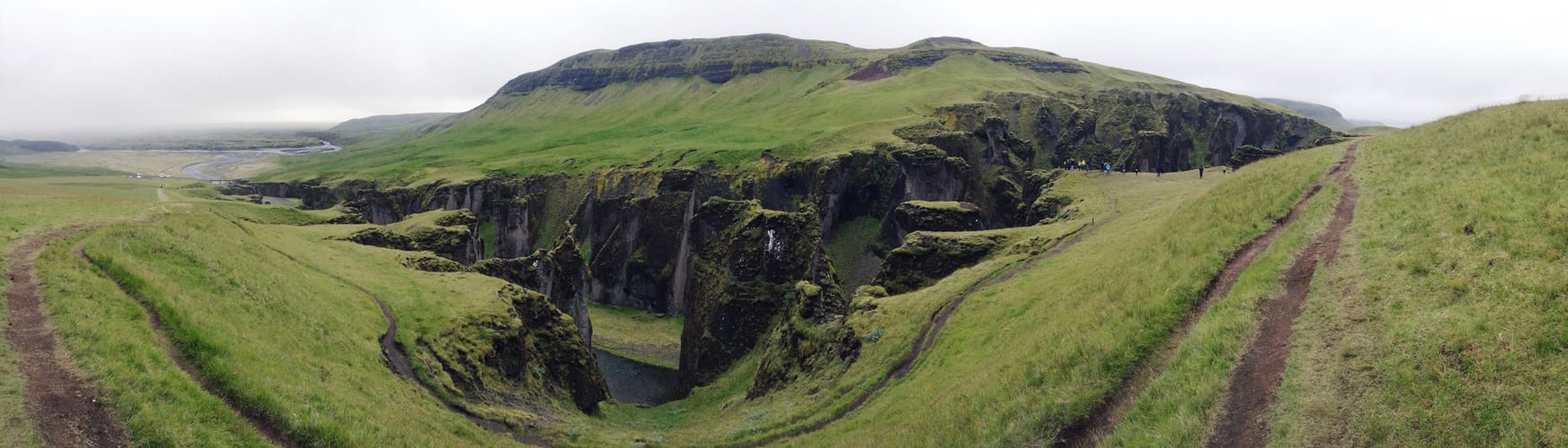
The canyon appears without warning. You round a low hill somewhere east of Kirkjubæjarklaustur, and suddenly the ground drops away into a long, ragged gash in the earth, with the Fjaðrá river threading quietly along the bottom a hundred metres below. It is one of those places where the scale takes a moment to register properly.
Why it’s worth the trip
Fjaðrárgljúfur is geologically young by planetary standards but ancient in human terms. The canyon formed roughly nine thousand years ago, carved by glacial meltwater at the end of the last ice age. The Fjaðrá river has continued shaping it since, cutting through layered basalt and palagonite to produce walls that read like a cross-section of Iceland’s volcanic history. The exposed strata are not a single uniform colour but a mixture of ochre, rust, grey, and dark green where moss has taken hold. On an overcast day the tones are muted and even. In low sunlight they become more distinct.
The canyon runs for roughly two kilometres and reaches depths of around a hundred metres at its most dramatic points. What makes it particularly good to visit is that the rim trail stays close to the edge for most of its length, meaning you get continuous views rather than a single payoff moment at the end. The river below winds in wide curves, and from above you can trace the full arc of each bend. The contrast between the narrow canyon walls and the relatively open valley floor at water level gives the place a vertical quality that photographs do not fully convey.
This is not a remote wilderness experience. It is a well-managed and popular site, and arriving with that expectation is the honest way to approach it. The experience is real. The crowds are also real.
How to get there
The canyon sits a short distance north of the Ring Road (Route 1), east of Kirkjubæjarklaustur. The turnoff is signposted, and the access road leads to a designated parking area. The road surface and facilities at the site change depending on season and recent management decisions, so checking current conditions through Safetravel or the Icelandic Road and Coastal Administration before visiting is a reasonable precaution, particularly early and late in the season.
Kirkjubæjarklaustur is the nearest settlement of any size, and it lies roughly halfway between Vík and Höfn on the Ring Road. If you are driving the south coast east-west, Fjaðrárgljúfur fits naturally as a stop in either direction. The drive from Reykjavík is several hours, so most people visiting this canyon are either on a multi-day trip or basing themselves somewhere along the south coast.
What to expect on arrival
The rim trail begins at the lower end of the canyon and runs to the head, where the Fjaðrá enters through a narrower, more enclosed section before the terrain flattens out. The round trip is roughly two kilometres, and the elevation gain along the rim is gradual rather than demanding. Most people in reasonable health will find it comfortable. The trail surface varies, and some sections involve uneven ground, short ascents over rocky outcrops, and exposed edges. The path is clear throughout.
Plan for around an hour and a half, which allows time to pause at the main viewpoints rather than simply walking through. Several of the best vantage points are signed or obvious from the trail. The view from the upper end of the canyon, looking back down its length, is particularly good for understanding the full shape of the feature.
The vegetation along the rim is low and wind-adapted, which means sightlines are generally clear. The canyon walls below support more lush growth wherever moisture collects in ledges and crevices. In spring and early summer, the contrast between the green rim and the darker rock faces below is noticeable.
Be aware that the trail does pass close to the edge at several points, and the drops are significant. There are no railings along most of the route. Children and dogs need to be managed with care.
When to go
Spring, summer, and early autumn are the practical seasons for this canyon. Late April through early October gives you reasonable daylight and trail conditions in most years. Midsummer brings the longest days and the most visitors. If you have flexibility, arriving early in the morning during peak months will give you quieter conditions and, on clear days, better light on the east-facing wall sections.
The canyon has been subject to temporary closures in the past to allow vegetation recovery after periods of high visitor numbers. These closures are managed by local authorities and are typically announced through official Icelandic tourism channels. It is worth checking the current status before making a long detour specifically for this site.
Weather on the south coast is changeable year-round. Rain and low cloud are common, and the canyon in mist has its own quality, with the far walls partially obscured and the sound of the river amplified from below. Snow and ice in winter make the rim trail hazardous and access uncertain.
Tips and responsible visitor notes
A few practical points worth keeping in mind:
- Stay on the marked trail. The rim vegetation is fragile, and footprints off-path persist for years in the slow-growing moss and sedge.
- Bring waterproof layers regardless of the forecast. Wind funnels through the canyon, and the temperature at the rim can feel significantly colder than in the parking area.
- The river itself is not safely accessible from the rim trail. Do not attempt to descend the canyon walls.
- Photography is best managed from the designated viewpoints rather than by scrambling toward the edge for a different angle. The rock is not always stable, and the margin for error is small.
- If visiting in summer, popular sites on Iceland’s south coast fill up quickly. Mid-week mornings tend to be quieter than weekends and afternoons.
Fjaðrárgljúfur rewards the visit when you approach it as what it is: a short, relatively easy walk along the edge of something genuinely old and geologically interesting. It does not require superlatives. The canyon speaks well enough for itself when you are standing at the rim with the river winding far below.
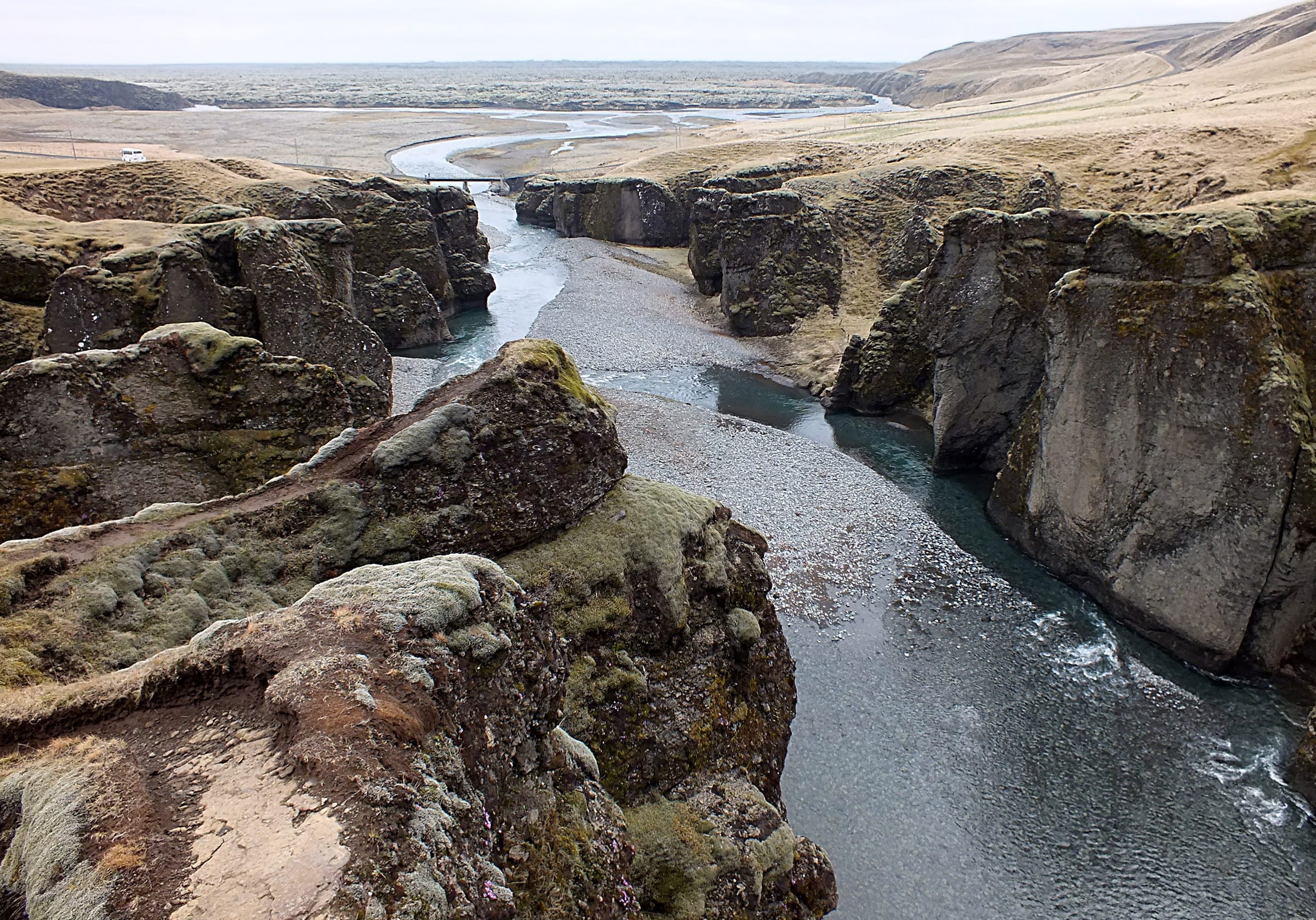
![500px provided description: A canyon near Kirkjub?jarklaustur, Southern Iceland. [#Kirkjub?jarklaustur ,#Landscape ,#Iceland ,#Fja?r?rglj?fur]](https://media.discover-iceland.com/fjadrargjufur-canyon/gallery-2.jpg)


.jpeg)